“I’m wearing a mask, and I’ve had my vaccine. I’ll be fine.”

During the pandemic, many of us believed exactly that. Masks and vaccines did significantly lower the risk of infection. But that sense of safety made no small number of people let their guard down.
Then one day, a coworker said, “Hmm, I think I’ve lost my sense of taste.” “You’re probably just imagining it,” everyone laughed — until, a few days later, that coworker tested positive. Contact tracing kicked in, and before anyone knew it, half the floor was flagged as a close contact. Many of us have a story just like this.
The tricky part was that so many people who felt “surely I’m fine” were, in fact, already infected — quietly passing the virus to family and colleagues without realizing it. By the time it was discovered, it had already spread to the people closest to them. That regret, that anxiety — many of us went through it more than once.
“If only I’d taken my temperature more often.” “If only I’d paid closer attention to how I was feeling.”
Sound familiar?
Website defacement exploits the same small lapses in judgment
“We have a firewall in place.” “We’re protected by a WAF.” “We’re on a secure cloud server.” Many website administrators think this way. But that’s very much like believing “I’m fine because I wear a mask and got vaccinated.”
Virus particles were small enough to slip through the gaps in a mask’s fibers. Vaccines, too, lost effectiveness against each new variant, locking us into a constant game of catch-up. And more than anything, it was often that one unguarded moment — taking off a mask to eat or talk — that let the virus spread.
WAFs and firewalls face the same kind of limits. A WAF works by matching traffic against known attack patterns, so it can’t fully defend against new techniques it hasn’t seen before (zero-day attacks). Attack methods keep evolving, and defensive rules can’t always keep pace — the same game of catch-up is playing out here too. On top of that, a WAF mainly guards the entry point of incoming traffic; it can’t cover risks from outdated CMS or plugin vulnerabilities, reused or leaked passwords, or a compromised vendor — risks that come from the “inside” or from people. Just as there was always that one moment a mask came off, there’s always a gap somewhere outside the defensive perimeter of a website.
And indeed, website defacement cases that quietly spread beneath the surface remain far from rare.
Website defacement is increasingly invisible to administrators
Many recent defacement techniques leave a site’s appearance completely unchanged, showing malicious pages only to search engines or select visitors. An administrator checking their own site in a browser sees nothing out of the ordinary. Simply “looking and checking” no longer works as a detection method.
Because the site still looks normal, the person in charge assumes everything is fine and goes about business as usual. Meanwhile, behind the scenes, files are quietly being altered, and malicious code is being embedded to redirect visitors to harmful sites. By the time anyone notices, the damage may have already reached a large number of visitors — and cases like this are far from unusual.
Detecting defacement requires a mechanism that tracks changes in the files themselves, not just how a site looks.
What happens if defacement goes undetected
Leaving defacement undetected doesn’t just affect what’s on the site — the damage spreads further. If a search engine detects malicious code, it may display a warning in search results or, in the worst case, remove the page entirely. Search rankings built up over years can vanish in a single day.
And if visitors are redirected to malicious sites or infected with malware, the damage isn’t limited to your own organization. A reputation for “you get infected just by visiting that site” can instantly erode the trust of partners and users alike. The time and cost of investigating the cause, restoring the site, and explaining the situation to stakeholders afterward are far from trivial.
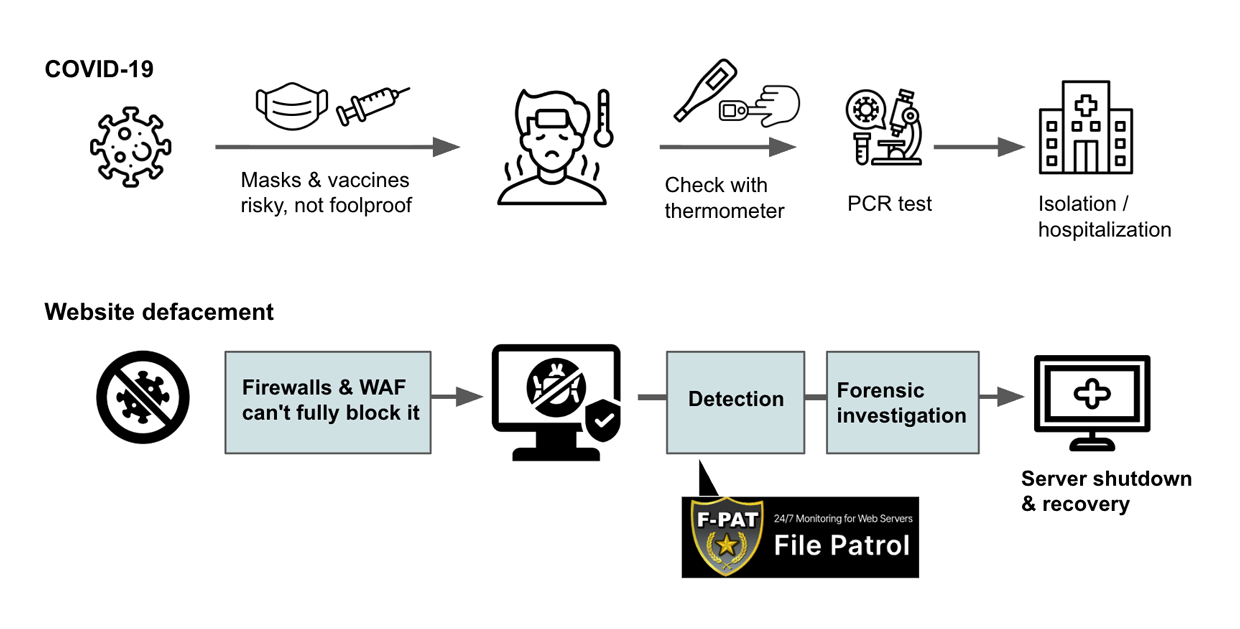
That’s exactly why it matters so much to notice something is wrong before the damage spreads out of control. With that in mind, let’s line up the COVID-19 comparison one more time.
| COVID-19 measure | What it does | Website security equivalent |
|---|---|---|
| Masks & vaccines | Lower risk, but can't fully prevent infection | Firewall / WAF |
| Thermometer & pulse oximeter | Detects unnoticed changes as numbers | F-PAT (defacement detection) |
| PCR test | Confirms exactly what you're infected with | Forensic investigation |
| Isolation / hospitalization | Response after confirmation | Server shutdown & recovery |
Why continuous, daily defacement detection matters
Another lesson from the pandemic: it wasn’t enough to test once and be done — testing had to happen every day. An annual health checkup alone can’t catch a sudden change that happens in between. The same is true for keeping a website safe. A one-time check at launch isn’t enough — only continuous, day-to-day monitoring delivers real value. This is exactly why modern supply-chain security assessments increasingly expect ongoing monitoring rather than a one-off check: the ability to notice has to become a habit, not a single event.
F-PAT is a service built to make exactly this kind of daily defacement detection possible — much like a thermometer or pulse oximeter. It monitors for changes that aren’t visible to the eye, day after day, so you can catch “something feels off” earlier than anyone else. Of course, F-PAT alone can’t pinpoint exactly what happened or where an intrusion came from — that’s the domain of forensic investigation, the equivalent of a PCR test. But as the pandemic taught us,
Without noticing that something is wrong, nothing else can begin.
To make sure we don’t repeat, on our websites, the regret of “if only we’d noticed sooner.”
Early detection is the first step toward keeping damage to a minimum. Consider F-PAT for website defacement detection.
Frequently asked questions about website defacement detection & protection
Consider F-PAT for website defacement detection
Start your free 1-month trial today. No setup fee, no credit card needed.